How Much Does Land Clearing Cost Per Acre in Michigan?
Published cost guides put land clearing at roughly $580 to $5,870 per acre. Light brush sits at the bottom of that spread. Heavy woods sit at the top. What is standing on your ground decides where you land.
A national contractor marketplace puts a typical whole job at $815 to $2,819, with a middle figure near $1,516. Those are market numbers from published guides, not our price list. Every land clearing job we quote around Bay City starts with a free estimate on the real lot.
What does an acre cost, by how thick the growth is?
Cost guides sort land clearing by how much is standing on the ground. The table below pulls per acre ranges from two published sources. One is a national home services cost guide updated for 2026. The other is a 2026 pricing guide written for clearing operators.
| What is on the acre | Published cost per acre | Source type |
|---|---|---|
| Brush and weeds, no real trees | $330 to $630 | national home services cost guide |
| Light brush, saplings under 3 inches | $500 to $2,000 | operator pricing guide |
| Lightly wooded, scattered trees | $580 to $2,100 | national home services cost guide |
| Thick brush with trees under 6 inches | $1,500 to $3,500 | operator pricing guide |
| Heavily wooded | $3,300 to $5,600 | national home services cost guide |
| Dense growth, large trees and vines | $3,000 to $6,000 | operator pricing guide |
| Mature hardwood stand | $4,000 to $8,000 | operator pricing guide |
That operator guide also breaks price out by region. It puts the Midwest at $1,500 to $4,000 an acre for forestry mulching, averaging $2,750. That is the closest published regional figure to Michigan we could find. Some contractors quote by the hour instead, and one national guide puts land clearing labor at $120 to $265 per hour.
What drives the price up or down?
Density moves the number more than anything else. The operator guide clocks light brush at 3 to 5 hours per acre. Dense brush mixed with 6 to 12 inch trees runs 8 to 12 hours or more.
Tree size is next. Trees over 8 inches usually have to be cut down before the rest gets ground up. That guide says some operators add $25 to $100 per tree for those.
Access matters too. When a trailer cannot pull up to the property, the same guide puts added mobilization at $500 to $1,500. Old fence wire, rock and buried concrete chew up mulcher teeth, and quotes reflect that risk.
Size cuts the other way. Most operators carry a minimum charge of $1,000 to $2,500 whatever the lot size. Jobs over 5 acres often see 10 to 25 percent off the per acre rate. If an old barn or shed sits in the clearing zone, that is demolition work and it prices on its own.
Is forestry mulching cheaper than conventional clearing?
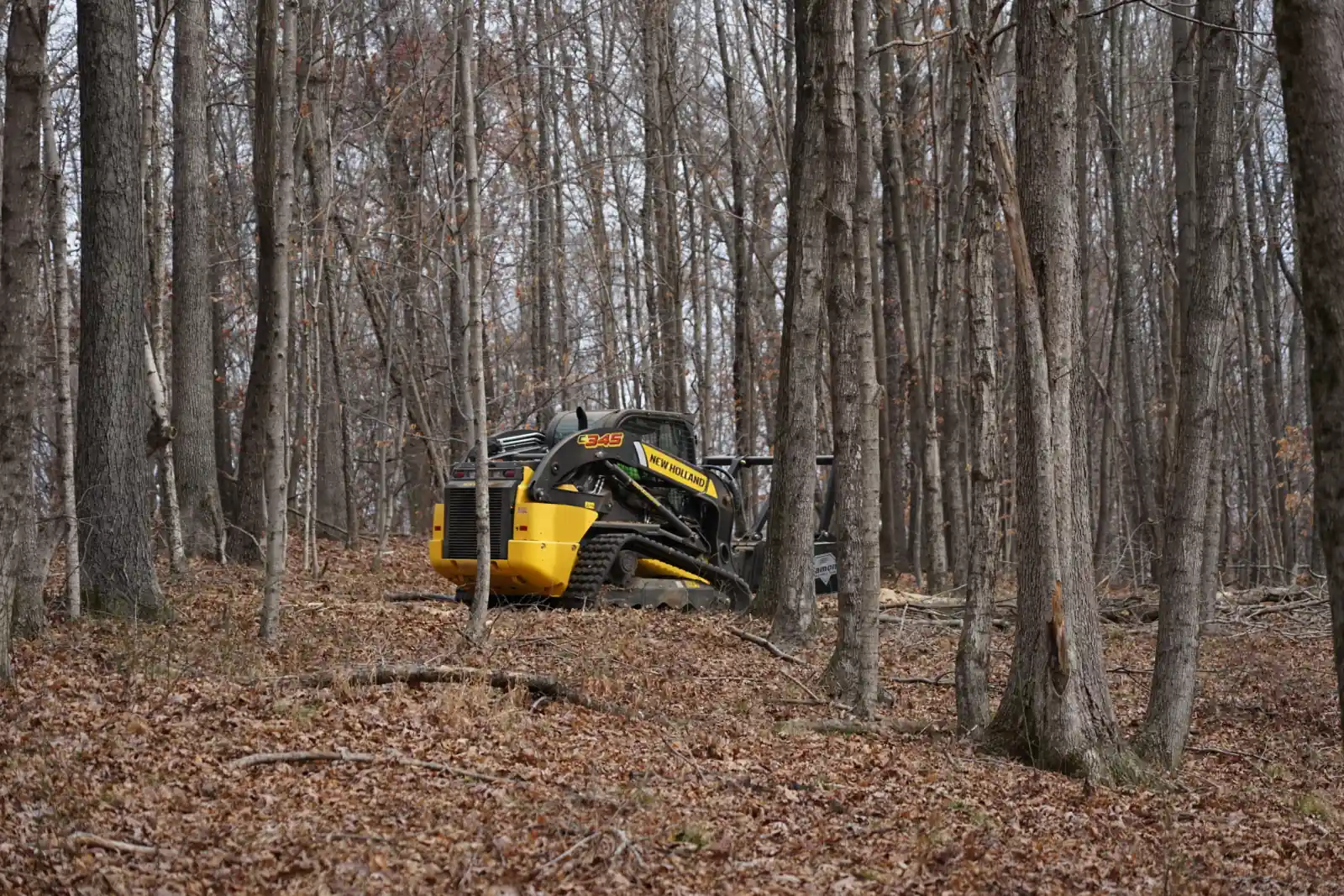
Usually. Forestry mulching grinds standing brush and small trees into chips in one pass. The chips stay on the ground as a mulch layer over the soil. Nothing gets piled, burned or trucked away.
The operator guide puts mulching at $1,500 to $4,000 an acre against $2,000 to $6,000 for conventional clearing. It adds $500 to $2,000 or more per acre for hauling and disposal on the conventional route. A national marketplace puts debris hauling near $135 per cubic yard.
| Method | Published cost per acre | What you end up with |
|---|---|---|
| Forestry mulching | $1,500 to $4,000 | chips left on site, topsoil stays put |
| Conventional clearing | $2,000 to $6,000 | bare dirt, material hauled off |
| Push clearing with a dozer | $1,800 to $5,500 | fast on open ground, large debris piles |
| Hand clearing | $3,000 to $8,000 | selective work in tight spots |
Mulching has a ceiling. That guide fits it to trunks up to roughly 6 to 15 inches, depending on the machine. Bigger timber gets felled first.
Burning is the third way to deal with a pile, and in Michigan it takes a permit. The DNR issues burn permits for the Upper Peninsula and the northern Lower Peninsula, and its county map shows the day’s status. In the southern Lower Peninsula, permits typically come from the local fire department or local governing body. EGLE air quality rules also block burning yard debris within 1,400 feet of an incorporated city or village limit, so we check the county before anything gets lit.
Does stump removal cost extra?
Often it does, and basic clearing quotes do not always include it. A national cost guide puts stump removal at $130 to $350 per stump. A contractor marketplace puts full removal at $200 to $300 and grinding at $160 to $250. The operator guide runs higher, at $150 to $500 per stump on a conventional job.
The spread is wide because size, soil and root ball depth all move it. Whether you need stumps gone depends on the plan for the ground. Pasture and trails can live with a ground stump. A building pad cannot, and if the lot is headed for a new home or detached garage, the root balls have to come out so the soil can be compacted.
How do wet clay and the seasons change the price?
Bay City sits on the old Saginaw lake plain. The soils here are heavy clay with a high water table and slow drainage. Water sits on top of that clay instead of soaking through it.
Wet clay costs money. Machines rut soft ground, work slower and pack the soil down hard. Frozen ground in late fall and winter carries equipment far better, and the leaves are off so the whole lot reads clearly.
Spring is the hard window. MDOT sets seasonal weight restrictions during the spring thaw, based on frost depth measurements and road conditions, and local road agencies set their own. Those limits can hold up trucking equipment in and debris out. That is one more reason mulching in place pencils out better in early spring.
What permits does land clearing need in Michigan?
Two checks come up on most jobs. The first is MISS DIG 811. Michigan law requires underground utility lines be marked before excavation, and the service is free. We file that notice and wait on the locates before ground gets disturbed.
The second is soil erosion. Part 91 of Michigan’s environmental act covers it. EGLE says a permit is generally required for earth change that disturbs one acre or more, or within 500 feet of a lake or stream. Counties appoint a County Enforcing Agency to review the plan and issue that permit.
Rules shift by township and by what the ground will be used for. We tell you what your job typically needs and handle the filings with you. The county and the state make the final call on all of it.
Getting a real number for your lot
Every figure above comes from published market research, not from us. Your acre prices out on what is standing and how big the trees are. Stump removal, disposal method and site access move it from there.
An estimate is free. Call or text (501) 520-1783 and we will look at the property and price it. See what the work covers on our brush removal and forestry mulching page. If one big dead tree over the house is the real problem, that is hazardous tree removal instead.